
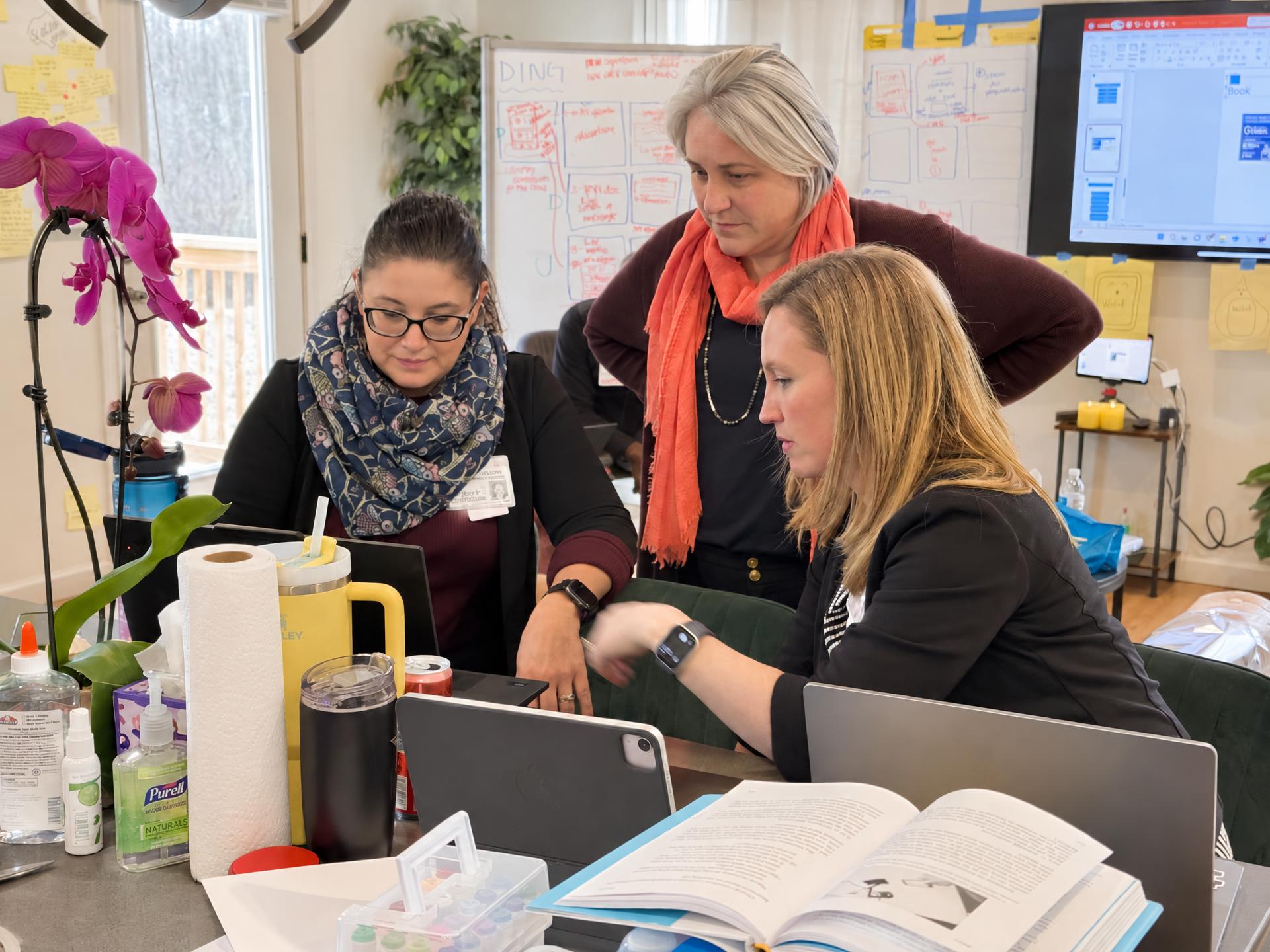
Three colleagues working together around a table with laptops and workshop notes

Chapter 3 is new.
The work behind it isn’t.

The work people hire us for today grew out of years spent doing it inside health systems and alongside healthcare organizations.

We’ve worked on patient access and experience, service and care models, digital products, innovation capability, organizational strategy and the hard work of making change succeed.

Much of that foundation was built at Baystate Health, where TechSpring launched in 2014 and later evolved into a broader Digital Innovation capability. Other work carried these ideas into health systems and healthcare technology organizations facing new kinds of change.

The examples below come from our founders’ prior roles. They are not presented as Chapter 3 client engagements or endorsements.

01

Experience, access & service design

Some of the hardest experience problems aren’t really “experience” problems. They cross scheduling, operations, clinical workflows, technology and the way care itself is organized.

At Baystate Health, our prior work included a multiyear strategy for orchestrated access; Virtual Care and Digital Front Door product management; care-model roadmaps across primary and specialty care; ambulatory-capacity work; patient journey mapping; Emergency Department experience; and patient onboarding.

The common thread was looking beyond the visible touchpoint to understand and redesign the system producing the experience.

02

Strategy, digital products & technology

Technology works better when the experience and operating model come first.

Our prior work ranged from helping develop digital-front-door standards and remote-monitoring solutions to designing patient-engagement tools and technology supporting team-based care.

With Praxify, a physician mobile application developed at Baystate Health, the work started with clinicians: observing their work, testing prototypes with them and continuing to improve the product after launch.

03

Innovation capability building

Sometimes the challenge isn’t one project. It’s building an organization that can repeatedly turn good ideas into better workflows and better care.

That was central to TechSpring. The work included creating a place and a model for healthcare innovation, connecting clinicians with technology teams, teaching human-centered design, running innovation programs, and developing governance structures that helped ideas move into real-world use.

This year, Jill brought that thinking to work with Inova Health System as it strengthened the organizational capability needed to evaluate, govern and scale AI. Jill led design work supporting that effort.

Becker’s Hospital Review later documented where Inova’s model had evolved: more than 12 AI project reviews each month, 92 AI features in production, centralized governance and post-deployment monitoring, distributed implementation, specialized AI product-management and solution-design roles, and AI education for employees, clinicians and leaders.

04

Succeeding with change

A good design can still fail if the organization around it doesn’t change.

Across our work, we’ve helped teams involve the people closest to the work, test new approaches before scaling them, clarify decision-making and governance, build new capabilities and roles, and create ways to keep learning after launch.

At Baystate, that included a Design and Experience Review Board, governance for informatics and technology requests, human-centered design education and innovation programs. At Inova, the broader work addressed the organizational structures needed to make increasingly complex AI decisions at scale.

For us, succeeding with change means leaving behind more than a recommendation or just implementing a technology product. The people doing the work should understand it, help shape it and be able to keep making it better.

05

Research & learning from real people

Human-centered design is also a way to learn.

In research on noninvasive ventilation, Jill McCormick and collaborators interviewed hospitalized patients with COPD and mapped their experience to understand what helped or hindered treatment tolerance.

The same principle runs through much of our work: spend time with the people living the problem, understand what is actually happening, and use what you learn to make the next version better.

A few places to go deeper.

Some of the work that shaped Chapter 3 has been documented through independent research, peer-reviewed publication and industry conversations. These sources offer a closer look at the work and thinking our founders bring forward.

  • The Role of Design in U.S. Health Systems

    Institute of Design at Illinois Tech · Equitable Healthcare Lab

    The 2024 report examines design across U.S. health systems and includes a detailed profile of Jill and Christian’s work leading Baystate Health Digital Innovation. It documents work spanning patient experience, digital transformation and product development, care-model redesign, strategy, organizational development, quality improvement, physical space design, workshops and clinical research.

    View the report →
  • Exploring the Patient Experience with Noninvasive Ventilation

    Chronic Obstructive Pulmonary Diseases: Journal of the COPD Foundation

    Peer-reviewed research co-authored by Jill McCormick applying human-centered design to the experience of hospitalized patients with COPD receiving noninvasive ventilation. The study used interviews and journey mapping to understand factors influencing patients’ tolerance of treatment.

    Read the paper →
  • Built for Care

    Public healthcare conversation

    A conversation with Jill McCormick and healthcare leaders about patient and provider experience in new construction, human-centered design, and the relationship between technology, operations and healthcare environments. This represents work that Jill and Christian led in the planning stages of a new hospital tower.

    Watch the conversation →
  • How to Succeed with Digital Innovation

    Society for Healthcare Strategy and Market Development

    A healthcare-industry article examining digital innovation and the organizational work required to make it successful.

    Read the article →
  • State of Patient Communications

    Industry webinar

    A public discussion focused on patient communications and the evolving healthcare experience.

    View the webinar →
  • Scaling AI at Inova

    Becker’s Hospital Review

    Becker’s reports on Inova Health System’s approach to scaling AI, including centralized governance and monitoring, distributed implementation, specialized product-management and solution-design roles, and organizational AI education.

    Read the article →

What comes next starts together.